Sensor Data Analytics Services

Sensor data analytics is required to collect and analyze data from sensor-equipped devices used in a variety of industries, including manufacturing, healthcare, retail, BFSI, oil and gas, automotive, energy, transportation, logistics, agricultural, smart cities, and others.

Ad hoc and real-time data analytics are enabled by such technologies to monitor environmental conditions, enhance asset use, and enable preventative maintenance. Sensor analytics solutions can also use AI/ML to identify key events, create extremely accurate forecasts, prevent long-term risks, and automate operations using intelligent instructions.

Implementation costs range from $70,000 to $500,000, depending on the number of linked sensors, the variety of data types, the complexity of analytics procedures, and other factors.

The implementation results in up to a 60% reduction in overall business costs.

Sensor Data Analytics: Key Features

By categorizing the key features into these two categories, it provides a clear understanding of the overall process of sensor data analytics, from processing and storage of sensor data to the analysis and reporting of meaningful insights.
Sensor Data Processing and Storage

  • Data Collection: Collection of data from various sensors deployed in the environment.
  • Data Preprocessing: Cleaning, filtering, normalization, and integration of sensor data.
  • Real-Time Analysis: Analyzing incoming sensor data in real-time or near-real-time.
  • Scalability and Performance: Handling large volumes of data generated by numerous sensors efficiently.
  • Security and Privacy: Ensuring data security and privacy measures for sensor data.

Sensor Data Analysis and Reporting

  • Advanced Analytics: Applying statistical analysis, machine learning, anomaly detection, and predictive modeling to extract insights from sensor data.
  • Visualization and Reporting: Presenting analyzed data through visualizations, charts, graphs, dashboards, and reports.
  • Integration with IoT Platforms: Integrating sensor data analytics with IoT platforms for seamless connectivity and data integration.
  • Real-Time Decision-Making: Enabling timely decision-making based on the latest sensor data insights.

Industry Specific Uses of Sensor Data Analytics

Manufacturing

  • Predictive maintenance: Sensor data can be used to predict when equipment is likely to fail, so that preventive maintenance can be performed. This can help to avoid costly downtime.
  • Quality control: Sensor data can be used to monitor the quality of products as they are being manufactured. This can help to identify and correct problems early on, before they cause defects in the final product.
  • Process optimization: Sensor data can be used to optimize manufacturing processes. This can help to improve efficiency and reduce costs.

Healthcare

  • Patient monitoring: Sensor data can be used to monitor patients in real time. This can help to identify and treat problems early on, before they become serious.
  • Fall detection: Sensor data can be used to detect falls in elderly patients. This can help to prevent injuries and improve quality of life.
  • Home healthcare: Sensor data can be used to monitor patients who are receiving home healthcare. This can help to ensure that they are receiving the care they need, without the need for hospitalization.

Automotive

  • Advanced driver assistance systems (ADAS): Sensor data is used to power ADAS features, such as adaptive cruise control and lane departure warning. These features can help to improve safety and reduce accidents.
  • Self-driving cars: Sensor data is essential for self-driving cars. The cars use sensor data to perceive their surroundings and make decisions about how to navigate.
  • Fleet management: Sensor data can be used to monitor and manage fleets of vehicles. This can help to improve efficiency and reduce costs.

Agriculture

  • Precision agriculture: Sensor data can be used to monitor crops and livestock in real time. This can help farmers to make better decisions about things like irrigation, fertilization, and pest control.
  • Smart farming: Sensor data can be used to automate many of the tasks involved in farming. This can help farmers to save time and money.
  • Food safety: Sensor data can be used to monitor food for contamination. This can help to prevent foodborne illness.

Oil & Gas

  • Production optimization: Sensor data can be used to optimize oil and gas production. This can help to improve efficiency and reduce costs.
  • Well integrity monitoring: Sensor data can be used to monitor well integrity. This can help to prevent leaks and spills.
  • Safety: Sensor data can be used to improve safety in oil and gas operations. This can help to prevent accidents and injuries.

Retail

  • Customer insights: Sensor data can be used to gain insights into customer behavior. This can help retailers to improve the customer experience and increase sales.
  • Inventory management: Sensor data can be used to track inventory levels. This can help retailers to avoid stockouts and overstocks.
  • Fraud detection: Sensor data can be used to detect fraud. This can help retailers to protect themselves from financial losses.

BFSI

  • Fraud detection: Sensor data can be used to detect fraud. This can help financial institutions to protect themselves from financial losses.
  • Risk management: Sensor data can be used to manage risk. This can help financial institutions to make better decisions about lending and investments.
  • Compliance: Sensor data can be used to ensure compliance with regulations. This can help financial institutions to avoid fines and penalties.

Transportation

  • Traffic management: Sensor data can be used to manage traffic. This can help to improve flow and reduce congestion.
  • Public transportation: Sensor data can be used to improve public transportation. This can help to make it more efficient and reliable.
  • Freight transportation: Sensor data can be used to improve freight transportation. This can help to make it more efficient and cost-effective.

Defence

  • Surveillance: Sensor data can be used for surveillance. This can help to detect and track threats.
  • Target identification: Sensor data can be used to identify targets. This can help to improve accuracy and reduce collateral damage.
  • Weapons guidance: Sensor data can be used to guide weapons. This can help to improve accuracy and reduce casualties.

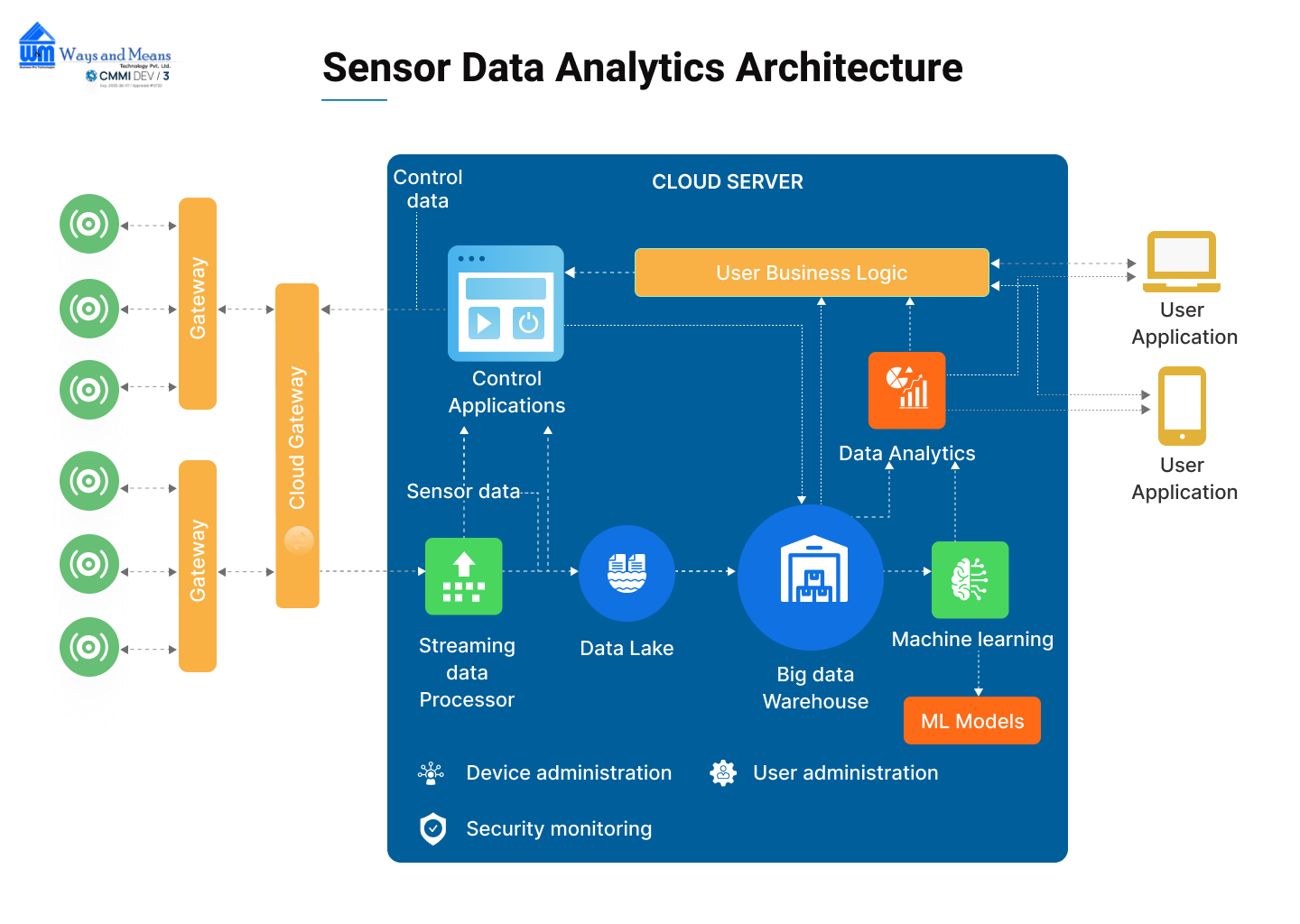
High Level Architecture of a Sensor Data Analytics Software

  • Sensors and smart devices collect data from the physical world.
  • The data is transmitted to a streaming data processor, which performs initial processing and then pushes the data in two directions:
    1. To control applications, which send commands to actuators if a pre-set event or anomaly is detected.
    2. To a data lake, where the data is stored until it needs to be analyzed.
  • After the data is transformed, cleaned, unified, and prepared for analytics, it is loaded into a big data warehouse.
  • The big data warehouse stores sensor data, sensor metadata, and data from control applications.
  • The big data warehouse is a source of high-quality data for analytics, machine learning, and user applications.
  • Analytics modules identify trends and dependencies in the data, generate reports, build forecasts, and offer recommendations.
  • Machine learning modules enable control applications to trigger actions.
  • User applications allow users to monitor sensor-equipped assets and their performance, send manual commands to control applications, fine-tune machine learning models, and create custom reports.

This architecture provides a flexible and scalable way to collect, store, and analyze sensor data. It can be used to improve operational efficiency, make better decisions, and gain new insights into the physical world.

Implementing Sensor Data Analytics Solutions: Costs and Benefits

The cost of implementing sensor data analytics systems varies according to the software's complexity. The cost of installation ranges from $20,000 to $500,000*.

$20K - $60K

For a sensor data analytics solution with the following characteristics:

  • Enables batch data processing.
  • Provides rule-based analytics.
  • Integrates with a limited number of sensor data sources and device types.

$60K - $150K

For a medium sensor data analytics solution with the following characteristics:

  • Enables batch data processing.
  • Provides rule-based analytics.
  • Integrates with a limited number of sensor data sources and device types.
  • Allows users to manually send commands to actuators.

$120K - $500K

For an advanced sensor data analytics solution with the following characteristics:

  • Enables batch data processing.
  • Provides rule-based analytics.
  • Integrates with a limited number of sensor data sources and device types.

Do you need a more specific figure?

Ways & Means Technology consultants are glad to provide a cost estimate for your sensor data analytics system.
Implementation of sensor data analytics system can bring:

  • Employee activity tracking and analytics-based optimization increased staff productivity by 57%.
  • Because to IoT-controlled resource use, energy consumption is reduced by 35%.
  • Sensor data analytics in smart city systems reduces water use and garbage collection expenses by 20%.
  • Smart shelves in retail resulted in a 50% reduction in out-of-stock SKUs.
  • Telematics analytics has resulted in a 15% decrease in insurance auto claims.
  • Soil moisture sensor data analytics in agriculture saves 50% on irrigation water volume.

Service Offerings

CONSULTING ON SENSOR ANALYTICS

Embracing sensor analytics represents a significant leap forward, and the skilled professionals at Ways and Means Technology are prepared to assist you in navigating potential pitfalls and fostering certainty in your venture. Our team will meticulously construct a comprehensive business case, provide accurate estimations of project costs and return on investment (ROI), devise a resilient architecture, and offer recommendations for the most suitable tool stack. By partnering with us, you can embark on your sensor analytics initiative with confidence.

I need this
IMPLEMENTATION SERVICE ON SENSOR ANALYTICS

Recognizing the criticality of executing large IT initiatives accurately from the outset, Ways and Means Technology is committed to prioritizing the development of a data analytics solution that is secure, scalable, and exceptionally efficient. Our foremost goal is to create a solution that will serve as a dependable cornerstone for your organization, catering to your needs for many years ahead. By harnessing our expertise and unwavering focus, we ensure the construction of a data analytics solution that guarantees longevity, enabling your organization to thrive in the long run.

I need this

Pre-Selecting Vendors for a Sensor Data Analytics Project?

  • 12+ year experience in Java development.
  • 100+ successful Java projects.
  • 800+ Happy Customers served globally
  • > 100 Expert developers.
  • 90% Repeat business – in itself a symbol of high level of customer satisfaction and delivery.

Industries we serve

Education
Healthcare
Entertainment
Banking
Business
Job/Carrier
Tourism
Hospitality
Food
Transport
Automobile
Real Estate
Sports
Dating
Social Networking
Manufacturing
Trading
Implex
BPM
Finance
Media
Have an App Idea
Have an Idea or Project?Have an idea or project in mind? Write to us. Our representative will get back to you shortly.

Frequently Asked Questions

Sensor data analytics can provide valuable insights into operational efficiency, predictive maintenance, anomaly detection, and resource optimization. It enables data-driven decision-making, automation, and improved overall performance.

How would Ways & Means Technology assist clients in accomplishing this?
Ways and Means Technology solves this problem by conducting a thorough assessment of your organization's needs and goals, identifying the specific areas where sensor data analytics can deliver maximum value. We design and implement tailored solutions that align with your business objectives.
Our sensor data analytics solution supports integration with a wide range of sensors, including temperature sensors, pressure sensors, motion sensors, and more. We ensure compatibility with various sensor types and data formats.

How would Ways & Means Technology assist clients in accomplishing this?
Ways and Means Technology addresses this concern by leveraging our expertise in working with diverse sensor technologies. We have experience integrating different sensor types, enabling comprehensive data analysis and insights across multiple domains.
Data security and privacy are of utmost importance to us. We employ robust security measures, including encryption, access controls, and compliance with relevant regulations, to protect your sensor data throughout the analytics process.

How would Ways & Means Technology assist clients in accomplishing this?
Ways and Means Technology prioritizes data security by implementing industry-leading security practices. We have extensive experience in safeguarding sensitive data, ensuring confidentiality, integrity, and compliance with data protection standards.
Yes, our sensor data analytics solution is designed to handle real-time data processing. It enables immediate analysis of incoming sensor data, allowing for real-time decision-making and prompt responses to critical events.

How would Ways & Means Technology assist clients in accomplishing this?
Ways and Means Technology addresses real-time data processing requirements by leveraging advanced technologies and scalable architectures. We ensure that the analytics solution can process and analyze sensor data in real-time, providing timely insights and actions.
Our sensor data analytics solution is built to handle large volumes of data generated by numerous sensors. It is designed with scalability in mind, allowing for efficient processing and analysis of data at any scale.

How would Ways & Means Technology assist clients in accomplishing this?
Ways and Means Technology tackles scalability challenges by utilizing scalable infrastructure and employing distributed computing techniques. We design the analytics solution to handle the growing demands of data volume, ensuring optimal performance and efficiency.
Yes, our sensor data analytics solution is designed to integrate seamlessly with your existing systems and databases. We ensure compatibility and provide integration capabilities with popular databases, data lakes, and enterprise systems.

How would Ways & Means Technology assist clients in accomplishing this?
Ways and Means Technology specializes in system integration and understands the importance of leveraging existing investments. We work closely with your team to integrate the analytics solution with your existing infrastructure, enabling a unified and cohesive ecosystem.
Our sensor data analytics solution provides a range of insights, including trends, patterns, anomalies, and predictive analytics. We generate reports and visualizations that offer a comprehensive understanding of your sensor data, enabling informed decision-making.

How would Ways & Means Technology assist clients in accomplishing this?
Ways and Means Technology excels in data visualization and reporting. We create intuitive dashboards, charts, and reports that effectively present insights derived from sensor data. Our solutions empower users to gain actionable insights and make data-driven decisions.
Yes, our sensor data analytics solution supports various data formats and protocols, ensuring compatibility with different sensors and data sources. It can handle structured, semi-structured, and unstructured data, facilitating a comprehensive analysis.

How would Ways & Means Technology assist clients in accomplishing this?
Ways and Means Technology addresses data format and protocol compatibility by utilizing flexible data ingestion and processing techniques. Our solution accommodates diverse data formats and protocols, enabling seamless integration with different sensors and sources.
The implementation timeline depends on the complexity and specific requirements of your project. We work closely with you to define project milestones and deliverables, ensuring a timely and efficient implementation process.

How would Ways & Means Technology assist clients in accomplishing this?
Ways and Means Technology follows a structured and agile implementation approach. We break down the project into manageable phases, providing regular updates and milestones. Our experienced team strives to deliver timely implementations without compromising quality.
We offer comprehensive support and maintenance services for the sensor data analytics solution. Our team provides continuous monitoring, troubleshooting, and updates to ensure the solution's optimal performance and address any emerging needs.

How would Ways & Means Technology assist clients in accomplishing this?
Ways and Means Technology is committed to long-term partnership and support. We provide ongoing support services to address any issues, perform regular maintenance, and incorporate new features or enhancements as your business evolves.

Hello Ways and Means Technology Private Limited
I have a query, can you help?

Progress component