



1. The Hidden Phase Where Operations Start to Struggle
There’s a phase most growing businesses pass through without really noticing.
Nothing breaks.
Nothing fails loudly.
Revenue may even be going up.
But day-to-day work starts feeling heavier.
Spreadsheets multiply. WhatsApp groups grow. Follow-ups get written on sticky notes or half-remembered during meetings. People start saying things like, “I’ll check and get back,” more often than they used to.
At this stage, operations don’t look chaotic from the outside. They just feel tight on the inside.
Every new customer adds a little pressure.
Every new service request needs more coordination.
Every renewal needs someone to remember, at the right time.
The systems that once worked are still there. They’re just being stretched beyond what they were designed for.
And because nothing is technically “broken,” this phase is easy to ignore. Most leaders assume the discomfort is temporary. That the team just needs to push a little harder.
In reality, this is usually the moment when operations stop scaling naturally and start relying on heroics.
2. Why Hard-Working Teams Still Feel Behind
When operations start slipping, effort usually goes up.
People stay late.
They respond faster.
They juggle more conversations at once.
Yet somehow, it still feels like things are always one step behind.
This isn’t a people problem. It’s a structure problem.
Teams spend their energy deciding what to do next instead of doing the work itself. Every day involves constant prioritization:
Which enquiry matters most?
Which service call is actually urgent?
Which client needs attention now, and which can wait?
That mental load adds up quickly.
Over time, experienced team members become walking systems. They carry context in their heads — customer history, contract status, past issues. When they’re unavailable, everything slows down.
Managers, meanwhile, spend more time chasing updates than reviewing outcomes. Meetings become status checks instead of planning sessions.
From the outside, it looks like the team is busy.
From the inside, it feels like running in place.
Hard work doesn’t disappear in this phase.
It just gets absorbed by coordination, guessing, and recovery.
And that’s usually the first real signal that operations need a rethink — not because people aren’t performing, but because the business has outgrown the way decisions are being made.
3. The Real Cost of Reactivity (That Rarely Shows on Dashboards)

Most businesses measure what is easy to count.
Revenue.
Leads.
Tickets closed.
Response times.
What often goes unmeasured is the cost of constantly reacting.
The Quiet Leaks in the System
Reactivity doesn’t usually cause visible failure.
It causes small, repeated misses.
An enquiry that didn’t get followed up on time.
A renewal conversation that started too late.
A service visit that could have been planned but wasn’t.
Individually, these feel manageable. Collectively, they add up.
Revenue doesn’t disappear overnight. It leaks slowly.
Stress as an Operational Expense
There’s also a cost that never appears in reports: mental load.
When everything feels urgent, teams operate in a permanent state of alert. People are always switching context, reprioritizing, apologizing, and catching up.
Over time:
- Decision quality drops
- Simple tasks take longer
- Escalations increase
- Fatigue becomes normal
The business keeps moving, but with more friction at every step.
Why Reactivity Scales Poorly
What works at a small scale often collapses quietly at a larger one.
A few urgent calls can be handled informally.
Dozens every day cannot.
As volume increases, reactivity doesn’t just slow things down. It makes outcomes unpredictable. Leaders lose confidence in forecasts. Teams lose confidence in plans.
And customers sense it — not through major failures, but through small inconsistencies.
That’s when trust starts to erode.
4. Why Traditional CRMs and Tools Don’t Solve This Problem
When operational pressure builds, the instinctive response is to add tools.
A new CRM.
Another dashboard.
More reports.
More alerts.
Yet many teams find themselves more overwhelmed than before.
CRMs Record Activity, They Don’t Guide Decisions
Most CRMs are good at storing information.
They track contacts, log interactions, and show pipelines.
What they don’t do well is help teams decide what matters right now.
They show everything equally.
Urgent and non-urgent sit side by side.
Context is scattered across tabs, notes, and timelines.
The result is visibility without clarity.
When More Tools Create More Noise
As businesses grow, tools accumulate.
One for sales.
One for service.
One for contracts.
One for inventory.
Each tool works fine on its own. The problem is what happens between them.
People become the integration layer.
Information is copied manually.
Decisions rely on who happens to know what.
Instead of reducing effort, tools start competing for attention.
Dashboards Don’t Fix Prioritization
Dashboards often answer the wrong question.
They show what is happening.
They don’t show what needs action first.
Without built-in prioritization, teams still rely on instinct and escalation. The dashboard becomes something managers check after the day is already over.
Why This Matters
The issue isn’t a lack of software.
It’s a lack of decision support.
Until systems help teams understand:
- what needs attention
- why it matters
- and when to act
adding more tools only makes operations louder, not better.
This is usually the moment when businesses realize they don’t need more visibility.
They need better structure around decisions.
5. What Actually Helps: Visibility, Prioritization, and Timing
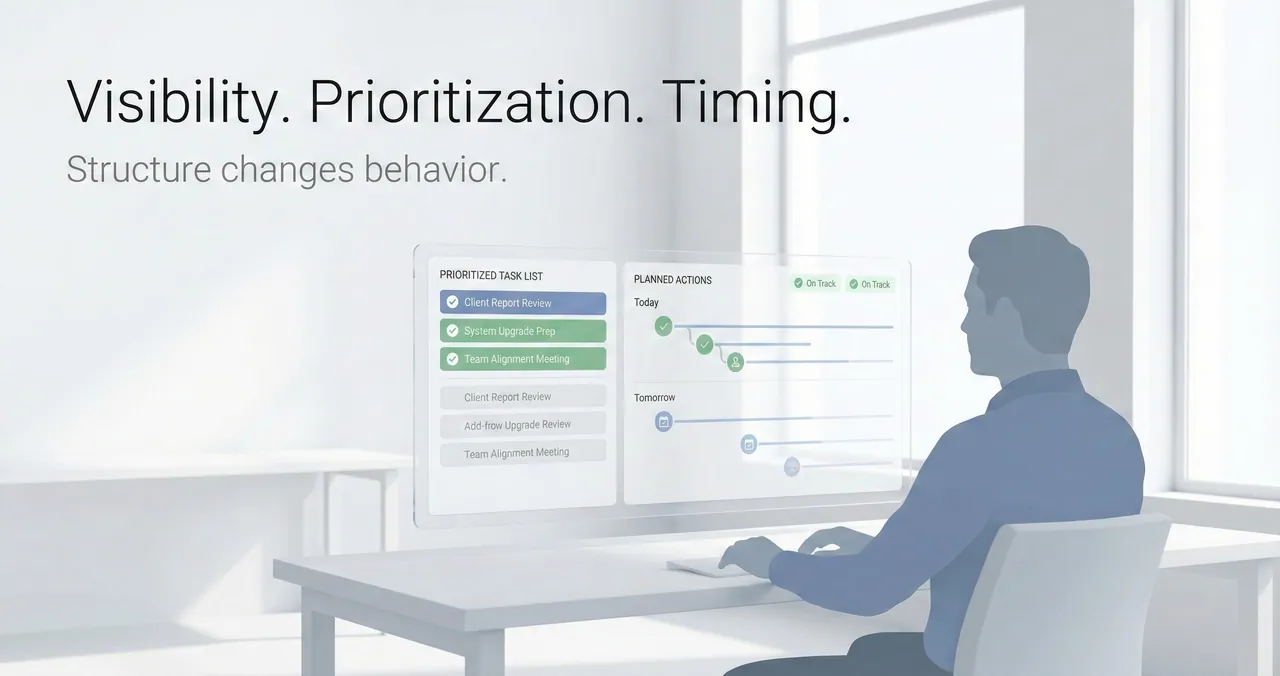
The problem isn’t a lack of data.
It’s an overload of it.
Teams already have information coming from everywhere. What they lack is a clear sense of what deserves attention first.
Visibility Comes Before Automation
Automation is tempting. It feels like progress.
But automating a messy process only helps the mess move faster.
What actually helps first is visibility that is:
- Shared across teams
- Consistent
- Grounded in real operational context
When everyone is looking at the same picture, conversations change. Less explaining. Fewer assumptions. Faster alignment.
Prioritization Changes Behavior
The biggest shift happens when systems start answering one simple question clearly:
“What should I work on right now?”
When priorities are obvious:
- Teams stop guessing
- Escalations reduce
- Urgency becomes meaningful again
Not everything needs immediate action.
Not everything deserves equal attention.
Good prioritization removes emotional decision-making from daily work.
Timing Matters More Than Speed
Many operational problems aren’t about being slow.
They’re about being late.
Renewals that start too close to expiry.
Service issues addressed after customers complain.
Inventory ordered only when stock runs out.
When timing improves, speed becomes less critical.
Work feels calmer because it is happening at the right moment, not under pressure.
6. Where AI Fits — Quietly
AI is often introduced with big expectations and louder promises.
In operations, that approach usually backfires.
The most effective use of AI is rarely visible.
AI as a Background Assistant
In strong operational systems, AI doesn’t replace people or make decisions on their behalf.
It works in the background to:
- Spot patterns humans miss
- Highlight risk early
- Suggest what deserves attention
Teams still decide.
AI simply improves the quality of the input they’re working with.
Less Noise, Better Judgment
Instead of flooding users with alerts, AI helps reduce noise.
It filters.
It prioritizes.
It brings forward what matters.
That’s when people start trusting the system — not because it’s impressive, but because it’s helpful.
Why Invisible AI Works Best
When AI stays out of the spotlight:
- Adoption is easier
- Resistance is lower
- Trust builds naturally
Teams don’t feel replaced. They feel supported.
From what we’ve seen, the goal isn’t to make AI visible.
It’s to make better decisions feel easier.
That’s when operations start to feel lighter — not because there’s less work, but because there’s less guessing.
7. What Operational Calm Actually Looks Like
Operational calm doesn’t mean fewer customers, fewer service calls, or less work.
It means fewer surprises.
In calmer operations, teams still move fast — but they’re no longer constantly reacting.
Planning Replaces Panic
Service schedules stop changing at the last minute.
Urgent issues are still handled quickly, but they stand out clearly instead of blending into noise.
Engineers know where they’re needed before the phone rings.
Service coordinators plan the day instead of reshuffling it.
The difference isn’t effort.
It’s foresight.
Renewals Become Conversations, Not Apologies
Renewal discussions start earlier.
There’s time to explain value.
There’s room to listen.
Instead of “We missed this,” the tone becomes, “Here’s what’s coming up.”
That shift alone changes how customers perceive the business.
Managers Review, They Don’t Chase
In calmer operations, managers stop asking: “Did this get done?”
They start asking: “What’s changing?”
Dashboards become review tools, not rescue tools.
Meetings become forward-looking instead of corrective.
Decisions feel intentional again.
Teams Feel the Difference First
One of the earliest signs of operational calm shows up in the team.
Less tension.
Fewer escalations.
Clearer handoffs.
People still work hard.
They just stop carrying unnecessary weight.
8. Signs You’re Ready for an Operations Rethink
Most businesses don’t decide to rethink operations.
They realize they’ve been postponing it.
If any of the following feel familiar, it’s usually a signal — not a failure.
You Rely on Memory More Than Systems
Important follow-ups live in someone’s head.
Context disappears when people are unavailable.
Experience fills gaps systems should cover.
Everything Feels Urgent, All the Time
True emergencies are hard to distinguish from routine issues.
Escalation becomes the default way to get attention.
Urgency loses meaning.
Growth Feels Heavy Instead of Exciting
New customers don’t just add opportunity.
They add coordination, tracking, and pressure.
Scaling starts to feel risky.
Leaders Feel Busy but Unsure
Decisions are being made constantly, yet confidence is low.
There’s activity everywhere, but clarity feels scarce.
The Thought Keeps Coming Back
“We should fix this properly.”
And then something urgent happens — and the thought gets postponed again.
That’s usually the moment worth paying attention to.
Because operational problems don’t disappear on their own.
They either get structured — or they get louder.
9. A Practical Way to Start (Without Big Disruption)
When teams realise operations need attention, the biggest fear is disruption.
Nobody wants to pause the business.
Nobody wants another long implementation that takes months before anything improves.
The good news is that meaningful change doesn’t require a big reset.
Start With One Pain Point
The most effective starting point is usually the one everyone already agrees on.
Missed follow-ups.
Late renewals.
Service prioritisation that depends on escalation.
Pick one area where the friction is visible and felt daily. Fixing that creates momentum and trust.
Focus on Decisions, Not Features
Instead of asking, “What software do we need?”
Ask, “Which decisions feel hardest to make right now?”
Good systems reduce uncertainty around:
- What needs attention
- Who owns it
- When it should happen
When decisions become easier, behaviour follows naturally.
Build Structure Gradually
Operational structure doesn’t have to arrive all at once.
Start with visibility.
Add prioritisation.
Then layer intelligence where it genuinely helps.
Teams adapt faster when systems grow with them instead of arriving fully formed.
Keep People at the Center
The goal is not to automate judgment away.
It’s to support it.
Systems should carry context so people don’t have to.
They should reduce noise so focus improves.
When teams feel supported rather than monitored, adoption happens quietly and sustainably.
10. A Closing Thought
Operational challenges are rarely about effort.
Most teams are already working hard.
Often harder than they should have to.
What breaks down first isn’t commitment — it’s structure.
When decisions rely on memory, urgency, and constant escalation, even strong teams struggle to stay ahead.
Calm operations aren’t a luxury.
They’re a competitive advantage.
Not because they slow things down, but because they allow the business to move deliberately.
The most effective systems don’t try to impress.
They quietly remove friction, uncertainty, and unnecessary stress.
And when that happens, growth stops feeling like a risk —
and starts feeling manageable again.