


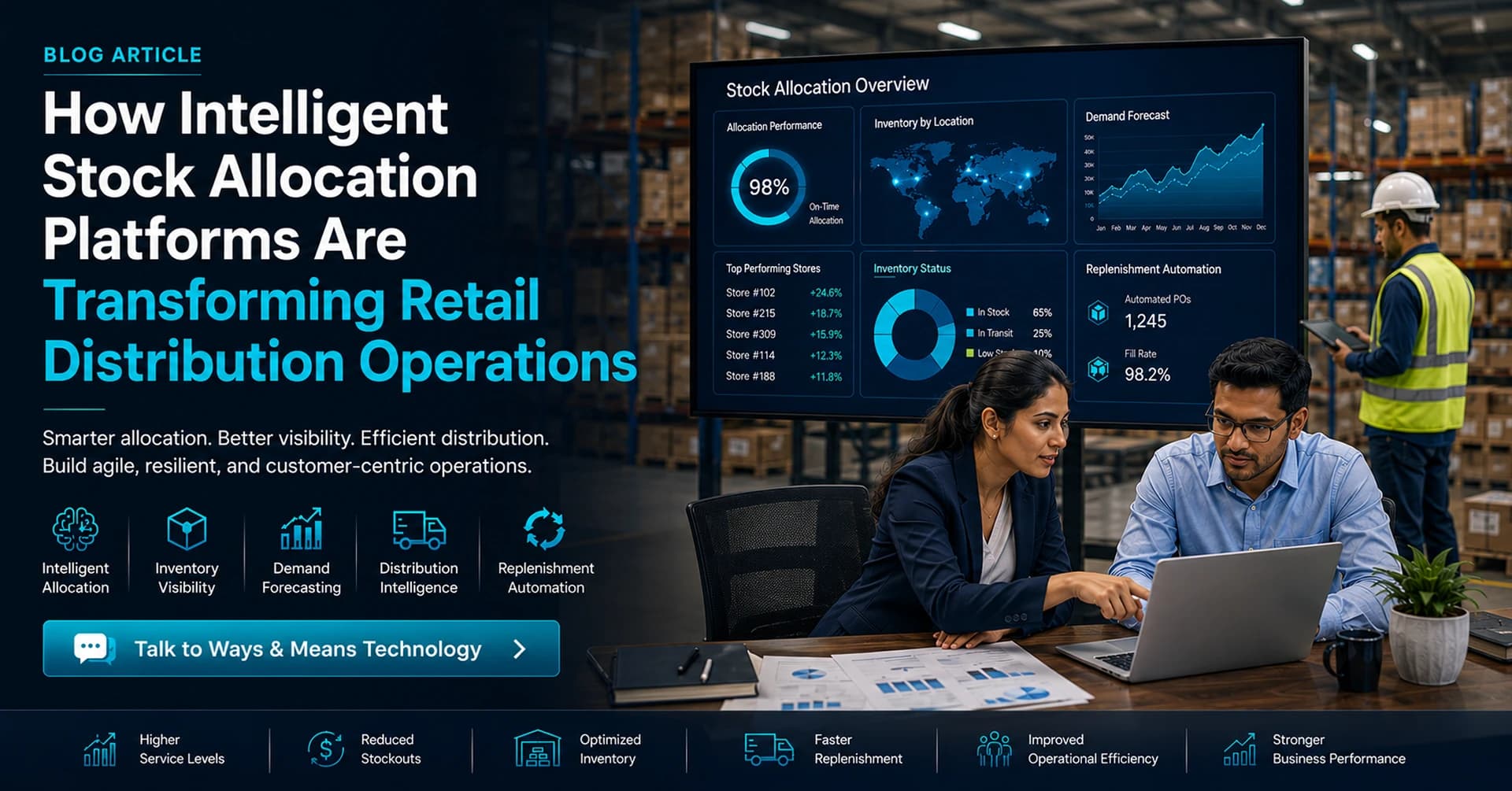
How Intelligent Stock Allocation Platforms are Transforming Retail Distribution Operations
Retail distribution looks simple from the outside.
Stock comes into a depot. Stores need products. Someone decides where the inventory should go.
That sounds clean enough.
But anyone who has worked even briefly around retail operations knows the truth is messier. A lot messier.
One product sells fast in one region and barely moves in another. A store that looked healthy last week suddenly runs low because of a local event. Seasonal products behave differently every year. One warehouse update is delayed. A shipment is stuck. Someone updates an allocation sheet manually, and now nobody is fully sure which number is final.
This is where many retail teams quietly lose time.
Not because the team is weak. Not because people are careless. The operation itself has become too complex for old allocation methods.
That is why intelligent stock allocation platforms are becoming important.
Not as “another software system.”
Retail teams already have enough systems.
The real value is in bringing allocation decisions, stock visibility, sales intelligence, replenishment logic, and distribution tracking into one connected operating layer.
What an Intelligent Stock Allocation Platform Actually Means
An intelligent stock allocation platform is not just a place to enter stock numbers.
That is the first misunderstanding.
A proper platform should help the business decide how inventory should move, where it should move, when it should move, and why.
It connects things that are usually scattered:
- depot stock
- store inventory
- SKU data
- sales history
- product categories
- store groups
- allocation rules
- delivery updates
- operational dashboards
When these pieces sit in separate spreadsheets or disconnected systems, teams spend half their time just trying to understand the situation.
When they come together, the conversation changes.
Instead of asking, “Which file has the latest stock position?”
The team can ask, “Which stores should receive priority based on sales, stock limits, and demand?”
That is a very different level of operation.
Why Traditional Allocation Processes Are Breaking Down
Spreadsheets worked when retail operations were smaller.
A few stores. Predictable stock movement. Limited SKUs. Slower replenishment cycles.
In that environment, manual allocation can survive.
But once the business grows, things start bending.
One allocation planner is comparing sales history. Another person is checking depot availability. A third person is adjusting store-level quantities. Someone else is waiting for courier updates. And somewhere in between, a manager asks for a quick stock position report before the next distribution cycle.
I have seen teams do all of this with spreadsheets, email threads, and shared folders.
It works until it doesn’t.
The first signs are usually small:
- allocation takes longer than expected
- stores question stock quantities
- duplicate files appear
- formulas become difficult to trust
- reporting is always slightly delayed
- one person becomes the only person who understands the process
That last one is dangerous.
When a business depends on one person’s spreadsheet logic, it is not really a process. It is a dependency.
The Shift from Inventory Management to Allocation Intelligence
Retail companies often talk about inventory management as if it is just stock counting.
But stock allocation is more strategic than that.
It directly affects:
- product availability
- store performance
- customer experience
- warehouse movement
- inventory holding cost
- replenishment speed
- sales conversion
A poor allocation decision does not always look dramatic at first.
Maybe one high-performing store receives too little stock. Another store receives too much. A slow-moving SKU sits in the wrong location. A seasonal product arrives late. Nobody notices immediately, but the cost shows up later in missed sales, markdowns, excess stock, and unnecessary transfers.
This is why allocation needs intelligence behind it.
Not guesswork.
Not only manual judgment.
A good allocation platform can help retail teams combine business rules with data. For example, the system can consider sales velocity, store type, past performance, depot stock, SKU relationships, maximum stock limits, and regional behavior before suggesting an allocation.
Human judgment still matters.
Frankly, it always will.
But the human should not have to fight scattered data before making a decision.
Centralized Inventory Visibility Changes the Way Teams Work
The first major benefit of an intelligent allocation platform is visibility.
And visibility sounds basic until you see what happens without it.
A depot team may know what stock is available. Store teams may know what they need. Sales teams may know what is moving. Finance may care about dead stock. Operations may care about distribution timing.
Everyone has part of the truth.
Nobody has the full picture.
Centralized inventory visibility brings these pieces into one place.
A planner can see depot stock. A manager can review store-level quantities. Leadership can view broader trends. Operations can track allocation status. If the platform is designed properly, the same source of truth supports everyone.
That reduces arguments.
It also reduces rework.
I have seen businesses save enormous time simply by stopping the daily back-and-forth around “latest numbers.”
Automated Allocation Logic Reduces Operational Drag
Manual allocation is slow because it requires repeated thinking on repeated patterns.
If Store A has strong sales for a product category, it usually needs priority.
If Store B has reached its maximum stock level, it should not receive more.
If a SKU is unavailable, a linked replacement SKU may need to be considered.
If the depot has limited quantity, the system should prioritize high-performing stores first.
These are not random decisions. They are rules.
And rules can be systemized.
An intelligent allocation platform can support methods like:
- sales-based allocation
- standfill-based allocation
- peak-week allocation
- store prioritization
- SKU linking
- store group allocation
- maximum quantity control
The point is not to remove human control.
The point is to remove repetitive manual calculation.
The best systems allow teams to review, adjust, approve, and export allocation decisions without rebuilding logic from scratch every time.
Retail Analytics Make Allocation Decisions More Practical
Dashboards are often treated as decoration.
That is a mistake.
In retail distribution, dashboards can be extremely practical when they answer operational questions quickly.
For example:
- Which stores are understocked?
- Which SKUs are moving fastest?
- Which product categories are slowing down?
- Where is depot stock concentrated?
- Which allocation was delayed?
- Which stores are repeatedly overstocked?
- Which region needs faster replenishment?
A useful retail analytics dashboard is not just a chart.
It is a decision-support layer.
It helps teams move faster because they do not need to manually prepare reports before every discussion.
This matters especially for leadership.
Senior teams do not want to inspect every SKU manually. They need patterns, exceptions, and direction.
Good dashboards show where attention is needed.
Store and Product Governance Become Easier
One thing people often underestimate is how many rules exist in retail operations.
Some stores should not receive certain products.
Some stores have maximum stock limits.
Some products belong to specific bands.
Some SKUs are linked across seasons.
Some stores are grouped under specific retail partners.
Some users should only view dashboards, while others can amend allocation data.
Without a proper system, these rules live inside people’s heads or spreadsheets.
That creates inconsistency.
A centralized allocation platform gives structure to these rules. Store groups can be managed. Product bands can be maintained. SKU relationships can be defined. User roles can be controlled.
This is boring work on paper.
But operationally, it is powerful.
Because once governance is built into the platform, the business becomes less dependent on memory and informal coordination.
Delivery Visibility Completes the Allocation Cycle
Allocation does not end when stock is assigned.
That is another common gap.
A team may create an allocation, but then the real-world movement begins:
- picking
- dispatch
- courier handover
- transit
- delivery
- delays
- exceptions
If delivery tracking is disconnected, operations teams only know half the story.
This is why courier integrations and allocation tracking matter.
When delivery status is connected back to allocation records, teams can monitor whether stock actually reached stores. They can identify delayed consignments. They can respond faster when shipments are stuck.
It turns allocation from a planning activity into a monitored operational workflow.
That is a big difference.
A Simple Example from Retail Operations
Imagine a retailer preparing allocation for a seasonal product.
There is limited depot stock. Some stores performed very well with similar products last year. A few stores have high footfall but low current stock. Another group of stores already has enough inventory. One region is expected to see stronger demand because of weather patterns or local buying behavior.
In a spreadsheet-heavy process, someone has to manually compare several files before making a decision.
In an intelligent allocation platform, much of that context can already be visible:
- depot availability
- historical sales
- store grouping
- SKU relationship
- stock limits
- regional performance
- allocation priority
The planner still makes the final call.
But the system reduces the noise.
That is where the value sits.
Not in making the operation look “digital.”
In helping people make better decisions faster.
The Role of Data in Modern Retail Allocation
Most retail businesses already have enough data.
That is not usually the problem.
The problem is that the data is scattered.
Sales data sits somewhere. Stock data somewhere else. Product masters are maintained separately. Delivery updates come from another system. Allocation history may be stored in files.
An intelligent allocation platform brings this data into usable shape.
That means:
- cleaner decisions
- faster reporting
- better exception handling
- stronger allocation consistency
- improved stock balancing
From what I have seen, the biggest improvement often comes when teams stop treating data as reporting material and start treating it as operational input.
Reports look backward.
Allocation intelligence helps the business act now.
Why Integration Readiness Matters
Retail operations rarely run on one system.
There may be ERP software, warehouse tools, sales systems, courier APIs, accounting platforms, reporting dashboards, and supplier portals.
A stock allocation platform should not become another isolated tool.
It should be designed to connect.
This is where architecture matters.
A scalable platform should support:
- APIs
- import/export workflows
- ERP integration
- courier integration
- reporting layers
- future forecasting systems
- role-based access
- audit trails
Some businesses may start with Excel import/export because that is practical for phase one.
That is fine.
But the platform should not be trapped there forever.
A good system gives the business a path from manual coordination toward connected operations.
The Future of Retail Distribution Is More Predictive
Retail distribution is moving toward smarter decision-making.
You can already see where this is heading.
Allocation platforms will increasingly support:
- demand forecasting
- predictive replenishment
- AI-assisted allocation recommendations
- automated exception alerts
- store-level performance prediction
- inventory risk detection
That does not mean every business needs AI on day one.
Actually, forcing AI too early can create confusion if the basics are not ready.
First, the data needs to be centralized.
Then the rules need to be structured.
Then dashboards need to be trusted.
After that, predictive intelligence becomes much more useful.
This is where many retail businesses should think carefully.
Do not jump straight to advanced forecasting if the allocation process is still sitting in scattered files.
Build the foundation first.
Intelligent Allocation Is Really an Operations Capability
The strongest retail businesses will not treat stock allocation as a back-office task forever.
It is becoming a serious operational capability.
A good allocation platform helps the business:
- reduce manual effort
- improve stock movement
- strengthen store availability
- reduce allocation errors
- improve distribution visibility
- support faster replenishment
- make better operational decisions
That is not just software value.
That is business value.
And frankly, the businesses that understand this earlier will have an advantage.
Because retail distribution is only going to become more dynamic.
More products. More channels. Faster cycles. Higher customer expectations. Less patience for stock mistakes.
Manual allocation methods will keep getting stretched.
Some teams will keep patching spreadsheets.
Others will build proper allocation intelligence.
The gap between the two will show up in speed, visibility, and operational control.