


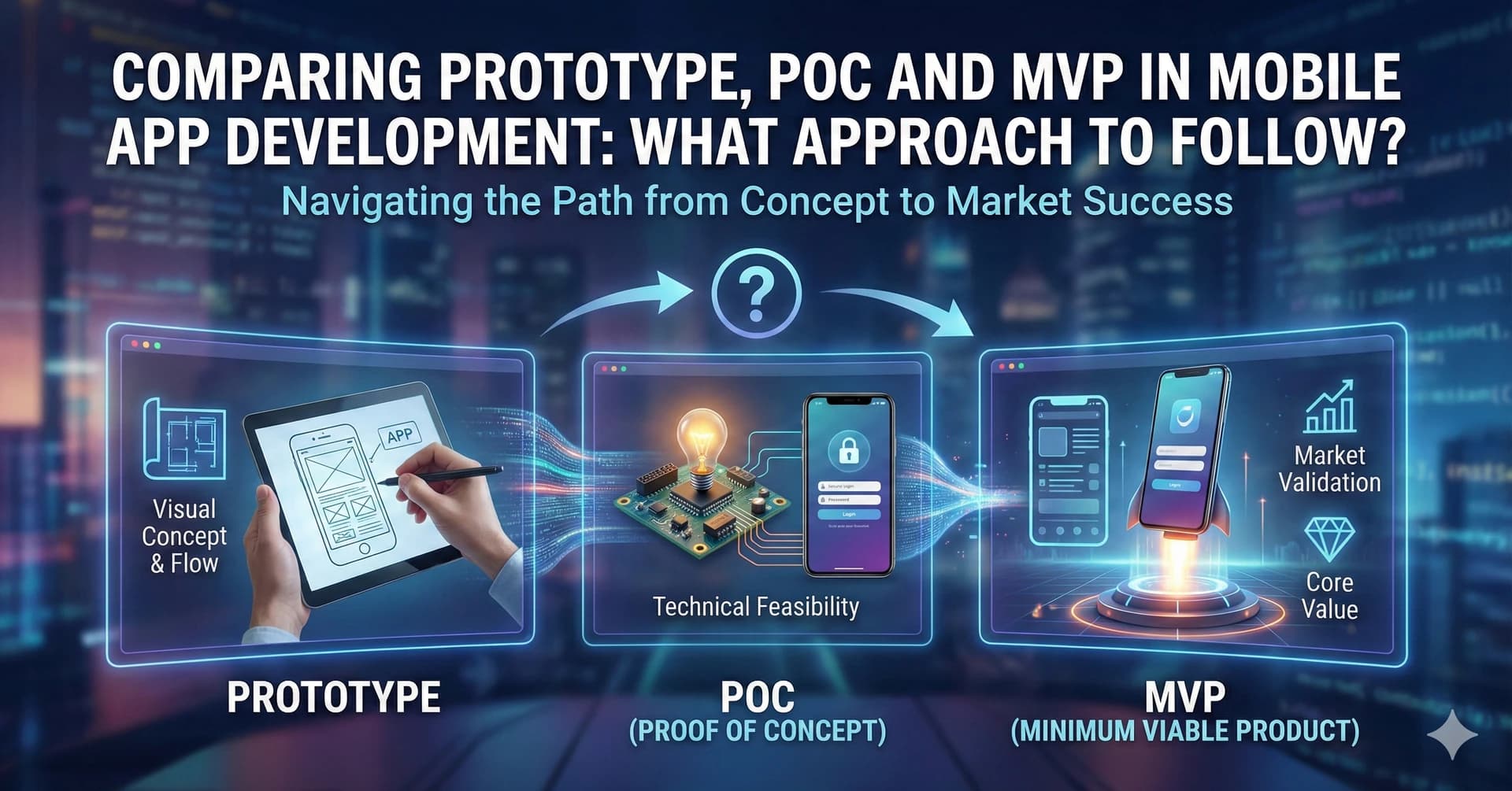
In mobile product development, particularly within the startup industry, it is common to encounter the terms proof-of-concept, prototype, and MVP. However, determining the appropriate utilization of these methodologies in a development plan can be a complex task. It is important to understand the distinctions between these three concepts in order to make informed decisions regarding budget allocation and potential success.
What is a Proof of Concept (POC)?
A Proof of Concept is the initial stage where you validate whether your idea is technically feasible. It's about answering the question: "Can this be built?"
- Key characteristics of POC:
- Focuses on technical viability
- Minimal functionality
- Internal evaluation tool
- Quick to develop
- Not intended for end users
What is a Prototype?
A prototype is a working model of your application that demonstrates the look, feel, and flow of your product. It's more refined than a POC and helps stakeholders visualize the end product.
- Key characteristics of Prototype:
- Visual representation
- Interactive elements
- User experience focused
- Used for gathering feedback
- May not have backend functionality
What is an MVP (Minimum Viable Product)?
An MVP is a functional version of your product with just enough features to satisfy early adopters and validate your business hypothesis in the market.
- Key characteristics of MVP:
- Fully functional product
- Core features only
- Released to real users
- Collects user feedback
- Validates market demand
When to Use Each Approach
- Use POC when:
- You're unsure about technical feasibility
- Testing new technologies
- Need to convince stakeholders about viability
- Working with limited budget initially
- Use Prototype when:
- You need to validate user experience
- Want to test design concepts
- Need to pitch to investors
- Gathering early feedback on UI/UX
- Use MVP when:
- Technical feasibility is confirmed
- Ready to test market demand
- Want to acquire early users
- Need real-world usage data
The Development Journey
Most successful mobile apps follow this progression:
- POC: Validate the core technical concept
- Prototype: Design and refine the user experience
- MVP: Launch a functional product to the market
- Full Product: Iterate based on user feedback
Making the Right Choice
The choice between POC, Prototype, and MVP depends on several factors:
- Stage of your idea: How developed is your concept?
- Budget constraints: What resources do you have available?
- Technical complexity: How challenging is the build?
- Market validation needs: Do you need to prove market demand?
- Investor requirements: What do stakeholders need to see?
Conclusion
Understanding the differences between Prototype, POC, and MVP is crucial for efficient resource allocation and project success. Start with a POC to validate technical feasibility, move to a Prototype to refine user experience, and finally launch an MVP to test your product in the real market.
Each approach serves a specific purpose in the product development lifecycle, and knowing when to use which can save you time, money, and help you build a product that truly meets market needs.