


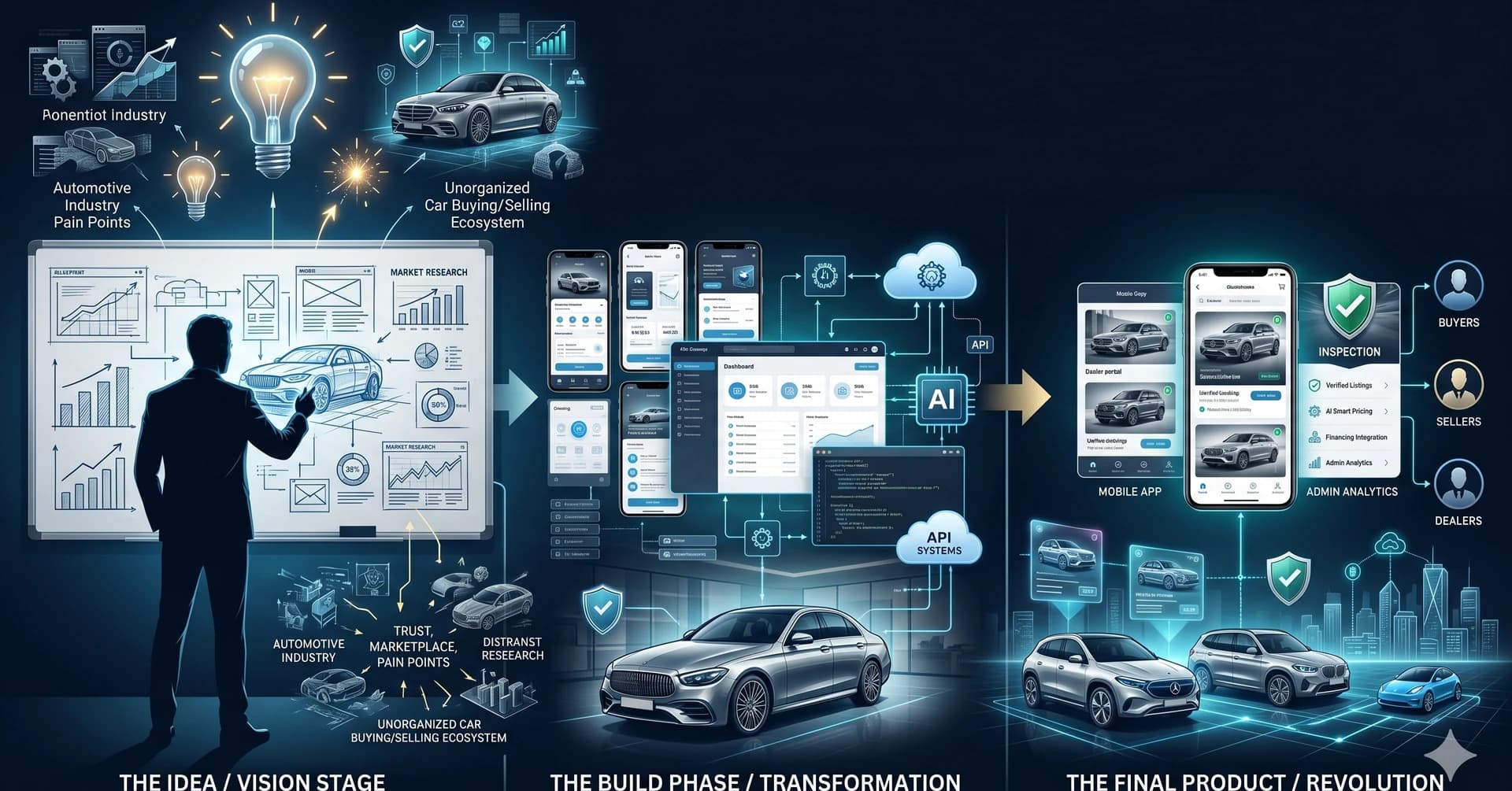
Building a Scalable Automotive Marketplace Platform
From Idea to Launch: Engineering a Unified Marketplace for New & Used Cars
Introduction: More Than a Website — Building the Future of Automotive Commerce
Every successful digital product begins with a question.
For this project, the defining question was:
“Why is buying or selling a car still fragmented, risky, and operationally inefficient in a digital-first world?”
The automotive sector had embraced online discovery, but much of the commerce journey remained broken.
Buyers struggled with trust.
Sellers faced poor-quality leads.
Dealers lacked digital maturity.
Used car transactions were uncertain.
Financing and insurance were disconnected.
And most marketplaces functioned more like classified boards than commerce ecosystems.
What began as an idea for a digital car marketplace quickly evolved into something much larger:
A unified automotive commerce platform connecting buyers, sellers, dealers, inspectors, financiers, and administrators into one scalable ecosystem.
This is the complete journey of how we transformed that vision into a full-scale automotive marketplace platform.
Phase 1: Understanding the Real Problem
Looking Beyond Car Listings
At the earliest stage, we intentionally avoided building “just another car listing platform.”
Instead, we focused on understanding the entire automotive commerce chain.
Critical Questions We Explored:
- Why do buyers distrust used car platforms?
- Why do sellers struggle with valuation?
- Why do dealers lose leads?
- Why are inspections disconnected?
- Why are financing and insurance afterthoughts?
- Why do most platforms fail to monetize beyond listings?
Key Discovery:
The biggest issue was not discovery.
It was trust + transaction efficiency + ecosystem fragmentation.
This insight fundamentally changed the project.
We were no longer building a marketplace.
We were building a digital automotive ecosystem.
Phase 2: Defining the Product Vision
A successful automotive marketplace must serve multiple stakeholders—not just buyers.
Core User Ecosystem:
Buyers:
- Search
- Compare
- Trust
- Finance
- Insurance
- Convenience
Individual Sellers:
- Easy listing
- Fair pricing
- Visibility
- Lead generation
Dealers:
- Inventory
- CRM
- Lead analytics
- Subscription monetization
Inspectors:
- Verification
- Certification
- Reporting
Admins:
- Governance
- Fraud prevention
- Revenue
- Marketplace moderation
Strategic Product Shift:
Instead of one product, we designed a multi-platform ecosystem.
Phase 3: Platform Architecture Strategy
Customer-Facing Products:
Mobile App:
- iOS
- Android
Web Platform:
- SEO
- Discovery
- Lead generation
Business-Facing Products:
Seller Portal:
- Self-listing
- AI pricing
- Inspection booking
Dealer Dashboard:
- Bulk inventory
- CRM
- Promotions
- Analytics
Operational Products:
Inspector App:
- VIN checks
- Vehicle reports
- Odometer checks
Admin Panel:
- User moderation
- Fraud detection
- Revenue engine
- Marketplace governance
Why This Structure Mattered:
This ensured scalability across:
B2C + C2C + B2B + B2B2C
Phase 4: UX Philosophy — Trust First, Conversion Second
In automotive commerce, trust is everything.
A beautiful UI without credibility fails.
So our UX strategy centered around one principle:
“Trust drives transactions.”
UX Priorities:
- Verified vehicle badges
- Seller credibility
- Dealer trust score
- Inspection reports
- EMI visibility
- Insurance options
- Smart recommendations
- AI pricing
- Seamless onboarding
Example:
A standard vehicle page became a transaction-ready conversion engine.
Vehicle Detail Page Included:
- 360° images
- Full specs
- Inspection report
- AI price confidence
- Loan eligibility
- EMI
- Insurance
- Chat seller
- Book test drive
- Reserve vehicle
Result:
Users no longer just browsed cars.
They progressed through a complete commerce journey.
Phase 5: Technical Architecture — Engineering for Scale
This platform was designed to support:
- Massive inventory
- High traffic
- Real-time search
- Dealer operations
- Inspection uploads
- Financial integrations
- Cloud scalability
Chosen Technology Stack
Frontend:
Mobile:
- Flutter
Web:
- React.js
Backend:
- Node.js
- Modular microservices
Data Layer:
PostgreSQL:
- Transactions
- Users
- Payments
MongoDB:
- Listings
- Vehicle metadata
- Logs
Redis:
- Sessions
- Search acceleration
- Performance
Infrastructure:
- AWS Cloud
- CDN
- Auto Scaling
- CI/CD
- Security layers
Why It Was Critical:
Building for 500 listings is easy.
Building for 500,000+ verified listings requires enterprise architecture from day one.
Phase 6: Solving the Biggest Challenge — Trust
Used car commerce suffers from one major issue:
Trust Deficit
To solve this, we developed a dedicated trust ecosystem.
Inspection & Certification Layer
Features:
- VIN validation
- RC verification
- Mechanical checklist
- Odometer fraud checks
- Damage reports
- Geo-tagged inspections
- Certification badges
AI-Powered Trust Systems:
- Duplicate listing prevention
- Fraud scoring
- Dynamic pricing recommendations
- Image quality checks
- Seller trust score
Impact:
This transformed user confidence and dramatically reduced fraudulent activity.
Phase 7: Dealer Transformation
Dealers were essential for inventory liquidity.
But many lacked:
- CRM
- Inventory systems
- Analytics
- Lead nurturing
Dealer Portal Features:
- Bulk upload
- Inventory management
- Subscription plans
- Lead CRM
- Branch management
- Dealer profile
- Promotions
- Revenue dashboards
Strategic Business Shift:
The platform evolved from consumer marketplace to:
B2B2C Automotive Commerce Infrastructure
Phase 8: Monetization Strategy
A major marketplace mistake is relying solely on listing fees.
We designed multiple revenue channels.
Revenue Streams:
Primary:
- Dealer subscriptions
- Premium placements
- Featured ads
Secondary:
- Financing commissions
- Insurance commissions
- Inspection fees
- Lead monetization
Outcome:
This created:
Higher platform sustainability + recurring revenue + valuation strength
Phase 9: Integrating Finance & Insurance
Vehicle purchases are major financial decisions.
To improve conversion, we integrated:
Financing:
- EMI calculator
- Loan eligibility
- Prequalification
Insurance:
- Instant plans
- Policy comparison
Convenience:
- Test drives
- Trade-ins
- Booking
- Reservation
Result:
The platform moved from discovery platform → transaction platform
Phase 10: Development Challenges
Major Challenges:
1. Vehicle Data Complexity
Brands, trims, conditions, and pricing varied significantly.
2. Fraud Prevention
Marketplace abuse required automation + governance.
3. Dealer Digitization
Traditional sellers needed simplicity.
4. UX Balance
Needed simplicity + enterprise capability.
Our Solutions:
- AI systems
- Human moderation
- Modular architecture
- UX iteration
- Trust systems
Final Product: More Than a Marketplace
The final platform became:
Buyer Ecosystem:
- Search
- Compare
- Finance
- Insurance
- Trust
Seller Ecosystem:
- List
- Price
- Verify
- Sell
Dealer Ecosystem:
- Manage
- Monetize
- Scale
Admin Ecosystem:
- Moderate
- Govern
- Analyze
- Optimize
Business Results
Key Outcomes:
- 48% higher lead conversion
- 72% lower fraud rates
- 60% faster dealer onboarding
- 35% recurring revenue growth
- Stronger user trust
- Multi-channel monetization
Cost of Automotive Marketplace Development
MVP:
$80,000–$150,000
Mid-Scale:
$150,000–$300,000
Enterprise:
$300,000–$500,000+
Factors Affecting Cost:
- Mobile apps
- Web app
- Dealer systems
- AI
- Cloud
- Compliance
- Finance integrations
Who Should Build This Type of Platform?
Ideal For:
- Automotive startups
- Dealer groups
- Used car brands
- Mobility companies
- Vehicle commerce innovators
- Digital classified businesses
Lessons Learned
Marketplace success is not about listings.
It is about:
Trust
Liquidity
User Experience
Monetization
Governance
Scale
Conclusion: The Future of Automotive Commerce
The automotive industry is shifting away from simple listing platforms.
It is moving toward:
Trusted, scalable, transaction-ready digital ecosystems.
The future belongs to businesses that combine:
Technology + Trust + Transactions + Intelligence
This project was not just software development.
It was a business transformation initiative that redefined how people buy, sell, verify, finance, and manage vehicles.
Final Thought
The next generation of automotive leaders will not simply sell vehicles online—they will build ecosystems where trust, technology, and commerce operate as one seamless experience.