


Introduction
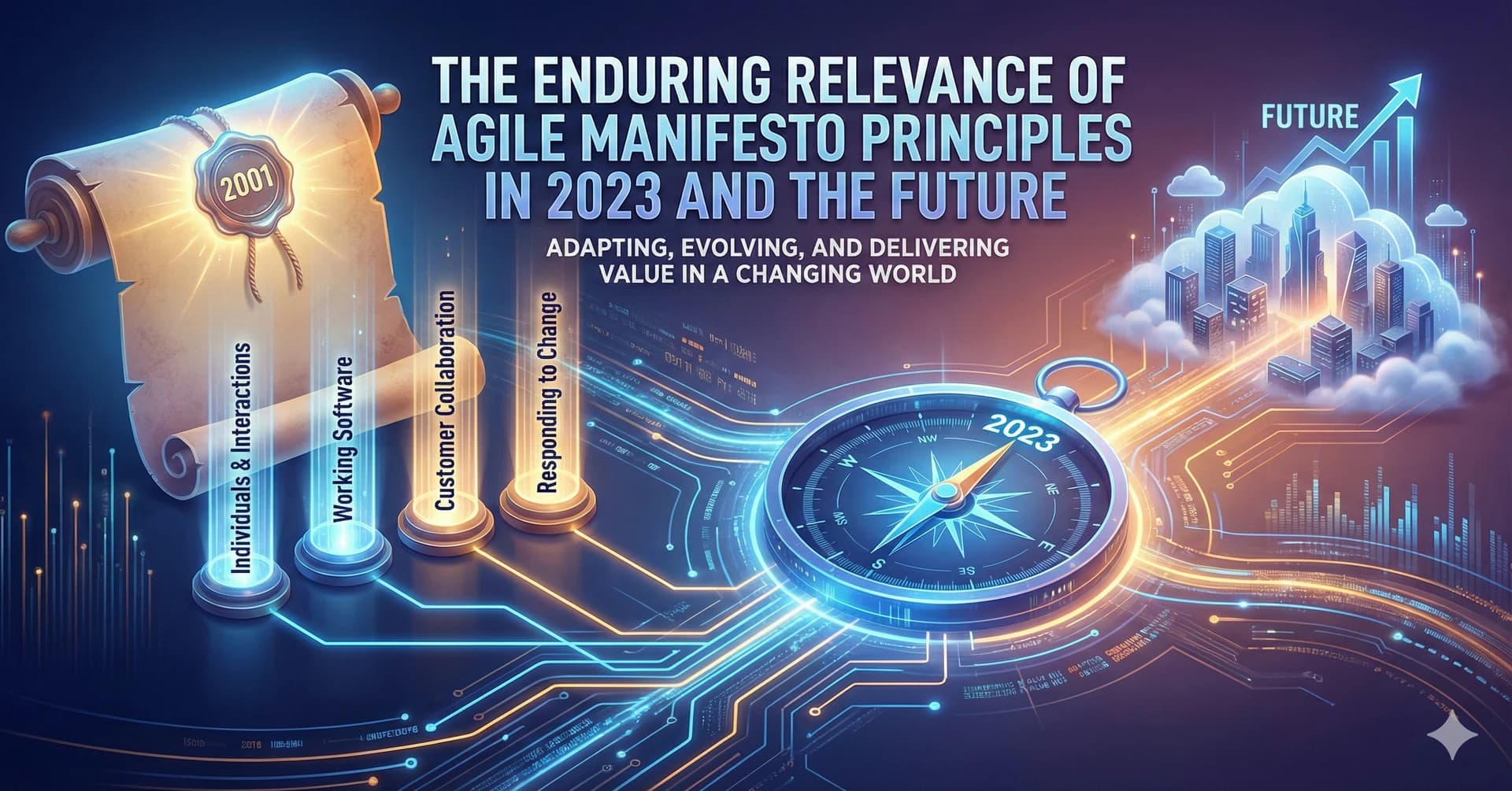
In the fast-paced world of software development, the Agile Manifesto has stood the test of time as a guiding framework for teams worldwide. Created in 2001, its four core values and twelve principles continue to shape how modern organizations approach software delivery, collaboration, and continuous improvement. This comprehensive guide explores how Agile principles remain relevant in 2023 and examines their adaptability for future technological landscapes through real-world case studies and insights from industry leaders.
The Four Core Values of the Agile Manifesto
-
- Individuals and Interactions Over Processes and Tools
The first value emphasizes the importance of human collaboration and communication. In 2023, with the rise of remote work and distributed teams, this principle has become even more critical. Teams that prioritize face-to-face communication (whether virtual or in-person) consistently outperform those that rely solely on rigid processes.
Case Study: Spotify's Squad Model
Spotify revolutionized team organization by creating autonomous squads that prioritize collaboration over hierarchical processes. Each squad operates like a mini-startup, making decisions collectively and adapting quickly to changes. This approach has enabled Spotify to scale effectively while maintaining agility and innovation.
-
- Working Software Over Comprehensive Documentation
While documentation remains important, Agile emphasizes delivering functional software that provides value to users. In today's fast-moving markets, the ability to release working features quickly gives organizations a competitive edge.
Case Study: Amazon's Two-Pizza Teams
Amazon famously implements the "two-pizza team" rule, where teams should be small enough to be fed by two pizzas. These small teams focus on shipping working software rapidly, with minimal documentation overhead. This approach has allowed Amazon to innovate at an unprecedented pace.
-
- Customer Collaboration Over Contract Negotiation
Agile encourages ongoing dialogue with customers rather than relying on fixed contracts. In 2023, with customer expectations constantly evolving, maintaining close customer relationships is essential for building products that truly meet market needs.
Case Study: Salesforce's Customer Success Approach
Salesforce has built its entire business model around continuous customer collaboration. Through regular feedback sessions, user groups, and the Trailblazer community, Salesforce maintains constant dialogue with customers, ensuring their products evolve in line with real user needs.
-
- Responding to Change Over Following a Plan
The ability to adapt quickly to changing requirements is perhaps the most defining characteristic of Agile. In an era of rapid technological advancement and shifting market dynamics, flexibility is no longer optional—it's essential.
Case Study: Netflix's Pivot from DVD Rentals to Streaming
Netflix's transformation from a DVD rental service to a streaming giant demonstrates the power of responding to change. By continuously adapting to technological shifts and customer preferences, Netflix has maintained its position as an industry leader.
The Twelve Agile Principles in Modern Context
- Principle 1: Customer Satisfaction Through Early and Continuous Delivery
In 2023, continuous delivery has evolved from a best practice to an industry standard. DevOps practices and CI/CD pipelines enable organizations to deploy updates multiple times per day, providing customers with rapid access to new features and improvements.
- Principle 2: Welcome Changing Requirements
Modern Agile teams embrace change as an opportunity for competitive advantage. Tools like feature flags and A/B testing enable teams to experiment and pivot quickly based on real user data.
- Principle 3: Deliver Working Software Frequently
The principle of frequent delivery has been amplified by microservices architecture and containerization. Organizations can now deploy individual services independently, increasing deployment frequency while reducing risk.
- Principle 4: Business and Developers Must Work Together Daily
Cross-functional teams have become the norm in Agile organizations. Product managers, developers, designers, and stakeholders collaborate daily, ensuring alignment and rapid decision-making.
- Principle 5: Build Projects Around Motivated Individuals
Employee engagement and motivation remain critical success factors. Organizations that invest in their people, provide autonomy, and foster a culture of trust consistently achieve better outcomes.
- Principle 6: Face-to-Face Conversation is Most Effective
While the definition of "face-to-face" has evolved to include video calls and virtual meetings, the principle remains relevant. Rich, synchronous communication channels facilitate better understanding and faster problem-solving.
- Principle 7: Working Software is the Primary Measure of Progress
Metrics like deployment frequency, lead time, and mean time to recovery have become standard ways to measure team effectiveness, all centered on delivering working software.
- Principle 8: Sustainable Development Pace
The importance of sustainable pace has gained recognition as organizations combat burnout and prioritize employee well-being. Teams that maintain consistent, sustainable velocity outperform those that sprint and crash.
- Principle 9: Continuous Attention to Technical Excellence
Technical debt management and code quality have become strategic priorities. Practices like test-driven development, pair programming, and regular refactoring help teams maintain high-quality codebases.
- Principle 10: Simplicity is Essential
The principle of simplicity applies to both code and processes. Minimal viable products (MVPs) and lean approaches help teams avoid over-engineering and focus on essential features.
- Principle 11: Self-Organizing Teams
Empowered, self-organizing teams are more innovative and productive. Organizations that provide autonomy and trust their teams to make decisions see better results than those with top-down management.
- Principle 12: Regular Reflection and Adjustment
Retrospectives and continuous improvement cycles remain fundamental to Agile success. Teams that regularly reflect on their processes and make adjustments continuously improve their performance.
Agile in 2023: New Challenges and Adaptations
- Remote and Hybrid Work
The shift to remote work has required Agile teams to adapt their practices. Virtual collaboration tools, asynchronous communication, and intentional culture-building have become essential components of modern Agile.
- Scale and Complexity
Frameworks like SAFe (Scaled Agile Framework), LeSS (Large Scale Scrum), and Spotify's model help organizations apply Agile principles at enterprise scale, managing dependencies and coordination across multiple teams.
- Integration with DevOps and Site Reliability Engineering
Agile has evolved beyond software development to encompass operations and reliability. DevOps practices, SRE principles, and platform engineering extend Agile thinking to the entire technology lifecycle.
- AI and Machine Learning Development
Agile principles are being adapted for AI/ML projects, which have unique characteristics like data dependency, model training cycles, and experimentation-heavy workflows.
Looking to the Future: Agile Beyond 2023
- Continued Evolution
As technology and business environments continue to evolve, Agile principles will adapt while maintaining their core focus on people, collaboration, and adaptability.
- Emerging Practices
- AI-Assisted Development: Agile teams are incorporating AI tools for code generation, testing, and decision support
- Continuous Discovery: Integrating user research and experimentation more deeply into development cycles
- Team Topologies: Organizing teams based on cognitive load and communication patterns for optimal effectiveness
- Universal Applicability
Agile principles are increasingly being applied beyond software development to marketing, HR, finance, and other business functions, demonstrating their universal relevance.
Conclusion
The Agile Manifesto's enduring relevance stems from its focus on fundamental human and organizational dynamics rather than specific technologies or processes. As we look to the future, the core values of collaboration, adaptability, customer focus, and continuous improvement will remain essential for success in an increasingly complex and fast-changing world.
Organizations that embrace these principles—while adapting their specific practices to their unique contexts—position themselves to thrive regardless of technological shifts or market disruptions. The Agile Manifesto isn't just relevant in 2023; it provides a timeless framework for building better products, teams, and organizations.